Red Roots Under Modern China

-

China moves swiftly to stabilize markets amid global financial turbulence
In a time of heightened uncertainty in the global trade environment and dramatic fluctuations in international financial markets, the timely and decisive action of China's state capital will effectively guide market expectations and mitigate the impact of external shocks.
2025-04-09
-

China to work with EU to promote sound, steady development of relations -- Premier Li
Protectionism leads nowhere, and only openness and cooperation represent the right path for mankind.
2025-04-09
-

Practical progress in bilateral ties urged
The talks came close on the heels of the meeting between President Xi Jinping and Indian Prime Minister Narendra Modi in Kazan, Russia, held less than a month ago. The meeting was described by Wang as a restart of bilateral ties.
2024-11-21
-
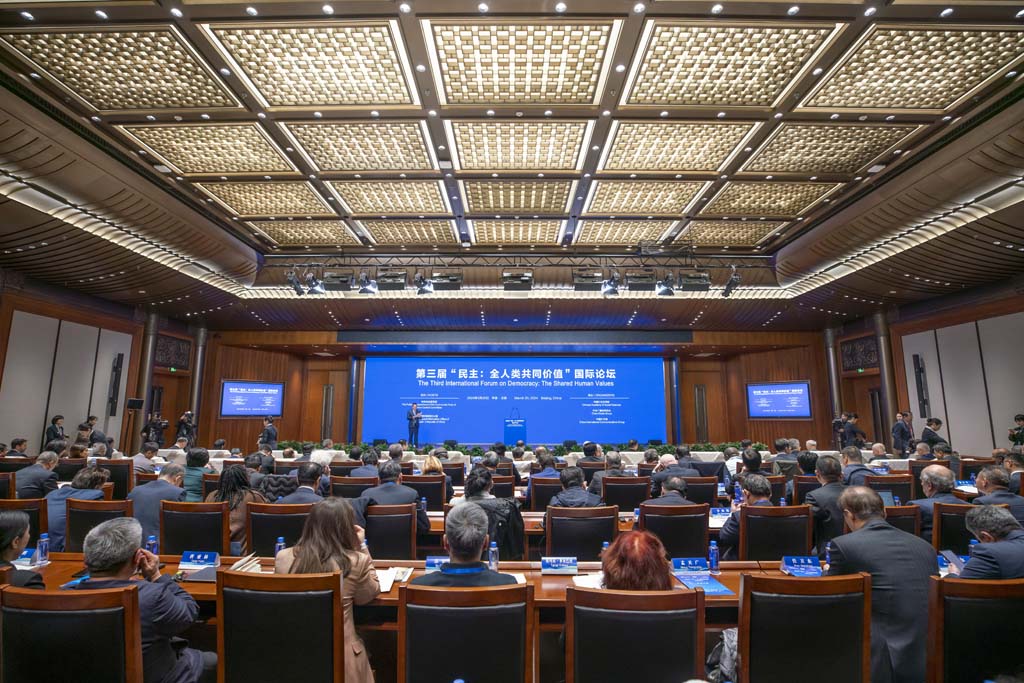
Beijing Hosts the Third International Forum on Democracy
The third International Forum on Democracy: The Shared Human Values, kicked off in Beijing on Wednesday. Over 200 guests from various countries, regions, and international organizations engaged in discussions to explore the essence of democracy and paths for mutual learning.
2024-03-20


By Eric Foster
This year marks the 90th anniversary of the victory of the Long March and of the interviews my uncle Edgar Snow conducted with Mao Zedong and other Red Army leaders in northern Shaanxi Province in 1936. These interviews formed the basis of his groundbreaking book, Red Star Over China, published in 1937, which helped introduce the Chinese revolution and the Long March to readers around the world. Nobel Prize-winning author Pearl S. Buck wrote that every page of this extraordinary record is filled with significance. Time magazine compared Snow’s reporting to be akin to Columbus discovering the new world.

Eric Foster displays a Chinese edition of Red Star Over China. The book introduced the Long March to readers around the world. (Photo courtesy of the author)
A Journey of Endurance and Sacrifice
In the account presented in the book, the Red Army crossed 18 mountain ranges, five of them snow-covered year-round, and 24 rivers. The journey took the troops across some of the most difficult terrain in China. Snow wrote, in the language of his time, “In one sense this mass migration was the biggest armed propaganda tour in history.”
The Red Army passed through many regions and communities, spreading its message and seeking the support of the rural population. The revolutionary program included land reform and opposition to landlord exploitation.
Many outside of China don’t fully grasp the significance of the Long March in Chinese history. If modern-day China were a tree, the Long March would be its roots, and a tree cannot survive without its roots. Today, the Long March remains a key component of the founding history and enduring legacy of modern China. It represents self-sacrifice, faith, courage, perseverance, determination, and hope. This spirit remains highly relevant today, inspiring us to keep exploring, overcome challenges, and pass on positive values across generations and borders.
For the past several months, I have enjoyed the privilege of visiting many sites along the Long March route while helping film different documentaries. Over the course of this year, I traveled from Yudu in Jiangxi Province, the starting point of the Central Red Army’s Long March, to northern Shaanxi, where the Central Red Army arrived in October 1935. I visited places my uncle only wrote about and never saw for himself as well as retracing Snow’s exact steps 90 years ago. It was inspiring and gratifying from a historical perspective and deeply moving on a personal level.
Visiting the many sites where the Long March actually took place, where famous battles were fought, and where young, brave Red Army soldiers gave their lives, left a lasting impression. At the sites and tombs we visited, I was moved by the many martyrs who sacrificed everything. From accounts cited in the book, we know that the Red Army averaged almost a skirmish a day and devoted 15 full days to major pitched battles.
There’s truly nothing like standing on those hallowed grounds in person—seeing the sheer scale of the mountains, the barren passes, the rushing rivers. It makes the sacrifice and determination of those who marched so much more palpable. Reading about it in a book can’t convey the exhaustion of climbing a ridge at altitude or the danger of a freezing river crossing. Being in the same space closes that gap between history and imagination. It’s one thing to know the Long March was arduous; it’s another to feel it in your bones. This is why these sites matter: They keep that memory alive, not just as dates and numbers, but as a real, human experience.
A Turning Point in the Revolution
One of the most brutal and heart-wrenching battles took place in late 1934 along the Xiangjiang River, not far from Guilin in Guangxi Zhuang Autonomous Region. The Xiangjiang River campaign remains one of the most painful episodes in the history of the Long March. The Central Red Army suffered devastating losses. Its strength fell from about 86,000 before the battle to just over 30,000 after. This heavy blow underscored the urgent need to reassess military strategy.
After the battle, the Red Army continued its march despite further battles and skirmishes. At the Zunyi Meeting in Guizhou Province in January 1935, Mao Zedong’s leadership position within the Central Committee of the Communist Party of China and the Red Army was established, marking a pivotal turning point in the history of the Chinese revolution.
This shift helped the Red Army adopt more flexible and mobile tactics. The Four Crossings of the Chishui River became one of the best-known examples of these maneuvers, helping the Red Army evade enemy forces and regain momentum before continuing its march westward.
The Long March was a strategic turning point that preserved revolutionary forces and empowered them to establish and consolidate a base in northern Shaanxi. Edgar Snow met Mao Zedong in Bao’an (present-day Zhidan County, Yan’an, Shaanxi Province), and his interviews became the basis for Red Star Over China. Helen Foster Snow later visited Yan’an and documented the experiences of Chinese revolutionaries, including women, in her own work, Inside Red China. Helen’s book also discusses the Long March, drawing on personal accounts and insights from women leaders who survived the journey.
The Long March remains important today not only because of its historical case study in determination, resilience, and perseverance, but also due to its enduring symbolic power: It is a story of survival, unity, and purpose that continues to inspire China. Without these roots planted by the Long March, China would be very different today.
The author is a nephew of Helen Foster Snow, wife of Edgar Snow, the author of Red Star Over China.